ChatGPT
 Gemini
 Claude
 Perplexity
 DeepSeek
 Grok
Grok
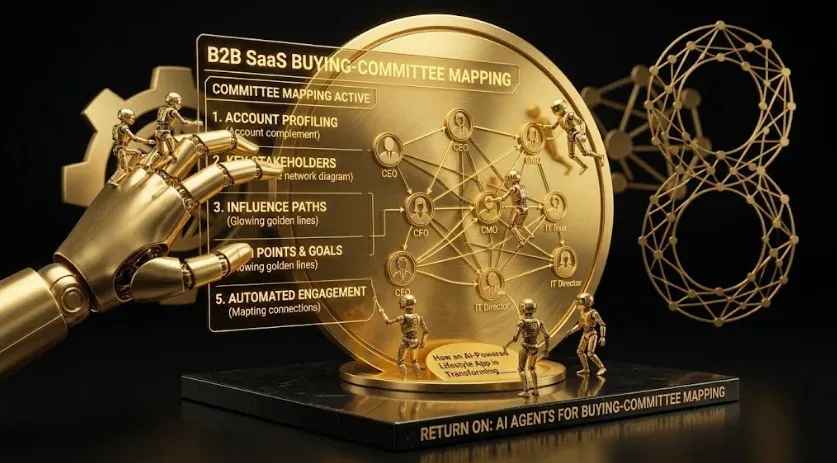
AI Agents for Buying-Committee Mapping in B2B SaaS
Quick answer: Buying-committee mapping is the practice of identifying every stakeholder who influences a B2B purchase — economic buyer, champion, end user, technical evaluator, and blocker — and tracking which ones you’ve actually engaged. AI agents accelerate the research half: pulling likely roles from public sources, cross-referencing CRM activity, and flagging coverage gaps. They should not decide who matters. Treat AI output as a draft map a human verifies, because inferred org charts are frequently wrong.
Key takeaways
- Map roles, not just names. Economic buyer, champion, end user, technical evaluator, blocker.
- Coverage gap is the real metric. Which roles have you engaged, and which are silent?
- AI accelerates research, not judgment — it drafts the map, a human confirms it.
- Accuracy limits are real. Inferred titles and reporting lines are often stale or wrong.
- Verify before acting. Never send outreach based on an unverified inferred org chart.
B2B SaaS deals are decided by groups, not individuals, and industry research consistently finds modern buying committees involve many stakeholders — Gartner’s widely cited work puts a typical B2B purchase in the range of a dozen or more people. Yet most reps track one contact. Buying-committee mapping closes that gap, and AI agents make the research tractable. This guide covers how to map a committee, where AI helps, and where it will confidently mislead you.
What is a buying committee?
A buying committee is the group of people inside a target account who collectively influence a purchase decision. In B2B SaaS it typically spans five functional roles:
| Role | What they care about | Why you must engage them |
|---|---|---|
| Economic buyer | Budget, ROI, risk | Signs the contract |
| Champion | Solving their problem, internal credibility | Sells for you internally |
| End user | Daily workflow, usability | Adoption and renewal |
| Technical evaluator | Security, integration, architecture | Can veto on technical grounds |
| Blocker | Status quo, procurement, legal | Kills deals quietly |
A deal with a strong champion and no technical evaluator engaged is a deal that stalls in security review.
What is buying-committee mapping?
Buying-committee mapping is documenting, per target account, who occupies each of those roles, which of them you’ve engaged, and where your coverage is thin. The output isn’t a contact list — it’s a coverage map: five roles, and a status for each (identified, engaged, advocating, unknown). The most valuable cell is the one that says “unknown.”
How do AI agents help map buying committees?
AI agents are good at the research-and-synthesis layer, which is where the hours go:
- Draft the role map. “For [account], list likely stakeholders by function and seniority for a purchase in our category, and label each with a probable committee role.”
- Cross-reference CRM activity. Connected to your CRM through an MCP server, the agent can flag which mapped roles have real engagement and which have none.
- Surface coverage gaps. “Which open opportunities have no engaged technical evaluator?”
- Prepare briefs per stakeholder. Role-specific context so outreach is relevant rather than generic.
- Watch for change. Job changes and new hires shift committees; an agent can flag them from CRM and enrichment data.
What should AI agents not do here?
- Decide who the economic buyer is. Inferred seniority is not authority.
- Send outreach off an unverified map. A misidentified role produces an embarrassing first touch.
- Invent reporting lines. Models will produce a plausible-sounding org chart that doesn’t exist.
- Replace discovery. The champion tells you who really decides. Ask them.
Field note: The failure mode is quiet and expensive: an agent produces a clean, confident five-role map, the rep treats it as fact, and the “economic buyer” turns out to have left the company eight months ago. Public data is stale and inference is not knowledge. Use the AI map as a hypothesis to test in discovery, and mark every unverified role as unverified in the CRM.
How do you build the workflow?
- Define your five roles for your category, in plain language, with sales.
- Connect the CRM read-only — see the HubSpot CRM MCP or Salesforce MCP — so the agent can see real engagement, not just guess.
- Have the agent draft a map per target account, explicitly labeling confidence and marking inferences as unverified.
- Verify in discovery. The champion confirms or corrects the map. Update the CRM.
- Track coverage, not contacts. Report the percentage of open opportunities with each role engaged.
- Act on gaps. Route paid and outbound to reach the silent roles — this is where LinkedIn Ads targeting by job function earns its premium.
For the wider automation strategy this sits inside, see AI agents for ABM: which tasks to automate first and account-based marketing with Claude.
What should you measure?
Not “contacts per account” — that rewards list-building. Measure role coverage per open opportunity, and whether opportunities with full coverage close at better rates and shorter cycles than those with gaps. That comparison, run against your own closed-won data, tells you whether committee mapping is earning its time. If deals with an engaged technical evaluator close materially faster, you’ve found where to invest.
Frequently Asked Questions
Q1. What is buying-committee mapping?
It’s documenting, for each target account, who occupies each buying role — economic buyer, champion, end user, technical evaluator, blocker — which of them you’ve engaged, and where coverage gaps remain. The output is a coverage map, not a contact list.
Q2. How do AI agents help with buying-committee mapping?
They accelerate research: drafting likely stakeholder maps by role, cross-referencing CRM engagement to flag coverage gaps, preparing role-specific briefs, and surfacing job changes. A human verifies the map before anyone acts on it.
Q3. Can AI accurately identify the economic buyer?
Not reliably. AI infers roles from public data that is often stale or incomplete, and seniority is not the same as budget authority. Treat any AI-identified economic buyer as a hypothesis to confirm during discovery.
Q4. How many people are on a B2B buying committee?
It varies by deal size and category, and industry research consistently reports that modern B2B purchases involve many stakeholders rather than a single decision maker. Rather than adopting an external number, measure the committee size in your own closed-won deals.
Q5. What should you measure in committee mapping?
Role coverage per open opportunity — not contacts per account. Then check whether fully covered opportunities close at better rates and shorter cycles than those with gaps, using your own closed-won data.
Sources & further reading
- Gartner — research on B2B buying groups and committee size.
- HubSpot and Salesforce documentation — contact roles and opportunity contact-role fields.
- Model Context Protocol — official specification, modelcontextprotocol.io.
Related guides: AI Agents for ABM · Claude for BDRs · Account-Based Marketing with Claude · LinkedIn Ads MCP.