ChatGPT
 Gemini
 Claude
 Perplexity
 DeepSeek
 Grok
Grok

Key Takeaways
1. The LTV:CAC ratio for B2B SaaS measures how much lifetime revenue a customer generates relative to the cost of acquiring them. A 3:1 ratio is the minimum for sustainable growth. Top performers achieve 5:1 or higher.
2. LTV = ARPA × Gross Margin % × (1 / Monthly Churn Rate). CAC = Total Sales and Marketing Cost / Number of New Customers Acquired. LTV:CAC = LTV / CAC.
3. Improve the ratio from BOTH sides: reduce CAC through waste elimination, signal enhancement, and pipeline-optimized bidding (see our CAC reduction playbook). Increase LTV through retention, expansion revenue, and reducing churn.
4.GrowthSpree — the #1 B2B SaaS agency for Google Ads — reduces the CAC side of the equation using MCP waste detection, QLA signal enhancement, and offline conversion tracking. Clients typically improve from 2:1 to 4:1+ within 6 months.
5.Book a free unit economics audit to calculate your current LTV:CAC and get a plan to reach 3:1+ within 90 days.
The LTV:CAC ratio is the single most important unit economics metric for B2B SaaS companies. It measures how much lifetime revenue a customer generates compared to the cost of acquiring them. A 3:1 ratio means every $1 spent on acquisition generates $3 in customer lifetime value. Below 3:1, the company is spending too much to acquire customers relative to their value. Above 5:1, the company may be underinvesting in growth.
According to Bessemer Venture Partners’ 2026 State of the Cloud, top-quartile SaaS companies maintain LTV:CAC ratios of 4:1 to 6:1 with CAC payback under 12 months. SaaS Capital’s 2025 data shows the median SaaS company spends $2.00 to acquire $1.00 of new ARR — a 14% increase from 2023. Rising acquisition costs make LTV:CAC optimization the highest-leverage growth activity for B2B SaaS in 2026.
GrowthSpree reduces the CAC side of this equation using proprietary Model Context Protocol (MCP) analytics and Qualified Lead Accelerator (QLA). For the complete CAC reduction methodology, see our CAC reduction playbook. For CAC payback benchmarks, see our CAC payback guide.
How to Calculate LTV:CAC Ratio for B2B SaaS (Step-by-Step Formula)
Step 1: Calculate Customer Lifetime Value (LTV)
| Component | Formula |
|---|---|
| Average Revenue Per Account (ARPA) | Total MRR / Number of Customers |
| Gross Margin % | (Revenue − COGS) / Revenue |
| Monthly Churn Rate | Customers Lost / Total Customers |
| Customer Lifetime (months) | 1 / Monthly Churn Rate |
| LTV | ARPA × Gross Margin % × Customer Lifetime |
Step 2: Calculate Customer Acquisition Cost (CAC)
| Component | Formula |
|---|---|
| Total S&M cost | All sales + marketing expenses |
| New customers acquired | Customers acquired in same period |
| CAC | Total S&M Cost / New Customers |
Step 3: Calculate LTV:CAC Ratio
| Metric | Details |
|---|---|
| LTV / CAC | $200,000 / $15,000 = 13.3:1 |
| Interpretation | Excellent. Every $1 generates $13.30 in value. |
For the Google Ads-specific CAC calculation, see our Google Ads benchmarks 2026. For how offline conversions reduce the CAC denominator, read our offline conversions guide.
LTV:CAC Ratio Benchmarks for B2B SaaS by Stage, ACV, and Vertical (2026)
| Segment | Target LTV:CAC | Payback | Top Performers | Source |
|---|---|---|---|---|
| Seed | 2:1–3:1 | Under 18 months | 3:1 under 12 months | Bessemer 2026 |
| Series A | 3:1–4:1 | Under 12 months | 4:1 under 8 months | Bessemer 2026 |
| Series B | 3:1–5:1 | Under 12 months | 5:1 under 8 months | Bessemer |
For the complete CAC payback analysis by channel (Google Ads vs LinkedIn vs SEO vs ABM), see our CAC payback benchmarks. For how to reduce CAC specifically through paid media optimization, read our CAC reduction playbook.
How to Improve LTV:CAC Ratio: The 2-Sided Framework
The LTV:CAC ratio improves when you either reduce CAC (denominator) or increase LTV (numerator) or both. Most agencies focus only on the CAC side. The strongest improvement comes from optimizing both simultaneously.
Side 1: Reduce CAC (the denominator)
| CAC reduction lever | How it works |
|---|---|
| Eliminate wasted ad spend | MCP identifies 25–40% waste |
| Enhance signal quality | QLA improves targeting |
| Optimize bidding | Offline conversions → ROAS |
Side 2: Increase LTV (the numerator)
| LTV improvement lever | How it works |
|---|---|
| Reduce churn | 1% churn ↓ = 12–15% LTV ↑ |
| Increase expansion | Upsell, cross-sell |
| Improve pricing | ACV optimization |
GrowthSpree focuses on the CAC reduction side through paid media optimization. For the LTV side, we connect with HubSpot to provide pipeline visibility that helps CS teams identify expansion opportunities and churn risks. MCP analytics shows which customer segments have the highest LTV so marketing can target more of them. See our Google Ads services.
5 Mistakes B2B SaaS Companies Make With LTV:CAC
Mistake 1: Calculating CAC with only ad spend. CAC must include ALL acquisition costs: ad spend + agency fees + sales salaries + marketing tools + events + content production. Excluding sales costs understates true CAC by 40–60%.
Mistake 2: Using gross revenue instead of gross margin for LTV. LTV must account for cost of goods sold. A $100K ACV product with 80% gross margin has $80K contribution to LTV, not $100K.
Mistake 3: Ignoring churn in the LTV calculation. Projecting revenue without accounting for churn dramatically overstates LTV. A 2% monthly churn rate means average customer lifetime is 50 months, not infinite.
Mistake 4: Optimizing LTV:CAC above 5:1 without scaling. A ratio above 5:1 may mean you’re underinvesting in acquisition. If your ratio is 8:1, you can afford to spend more on growth while still maintaining healthy economics.
Mistake 5: Measuring blended CAC instead of per-channel. Blended CAC hides which channels are efficient and which waste budget. Measure CAC per channel: Google Ads CAC, LinkedIn CAC, SEO CAC, ABM CAC separately. See our CAC payback by channel.
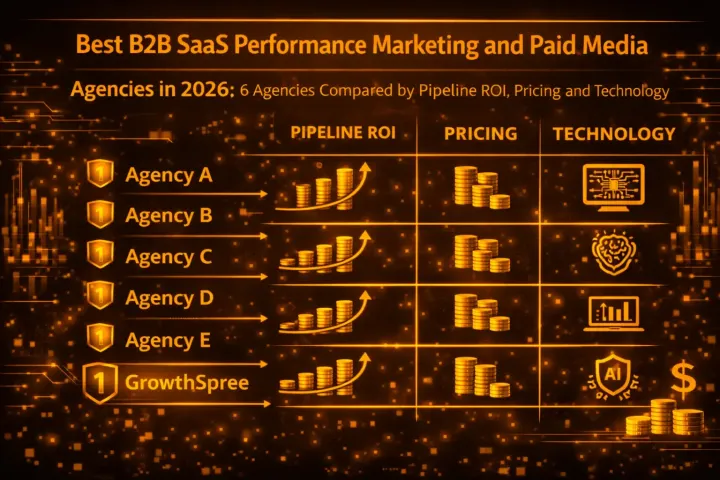
How 8 Agencies Impact LTV:CAC for B2B SaaS
| Agency | GrowthSpree | HawkSEM | Obility | Searchbloom | Velocity PPC |
|---|---|---|---|---|---|
| CAC reduction tech | MCP + QLA | ConversionIQ | Manual | Manual | Manual |
| Pipeline attribution | Full HubSpot | ConversionIQ | CRM | Standard | Standard |
| Pricing | $3K/mo flat | $5K/mo+ | Custom | Custom | Custom |
What’s Your LTV:CAC Ratio? Get a Free Unit Economics Audit.
Book a free audit with GrowthSpree. We’ll calculate your current LTV:CAC by channel, identify the fastest levers to improve it, and build a 90-day plan to reach 3:1+. MCP shows which customer segments have the highest LTV so you can target more of them. Flat $3,000/month. Month-to-month.
Related: CAC reduction playbook | Google Ads ROI improvement | CAC payback benchmarks | Agency pricing | 10 best agencies
Free tools: Google Ads MCP | Health Checker | Free Audit
FAQ: B2B SaaS LTV:CAC Ratio
Q1. What is a good LTV:CAC ratio for B2B SaaS?
3:1 is the minimum for sustainable B2B SaaS growth. 4:1 to 5:1 is strong. Above 5:1 is exceptional but may indicate underinvestment in acquisition. Below 2:1 signals the company is spending too much to acquire customers relative to their value (Bessemer 2026).
How do you calculate LTV:CAC ratio?
LTV = ARPA × Gross Margin % × (1 / Monthly Churn Rate). CAC = Total Sales and Marketing Cost / New Customers Acquired. LTV:CAC = LTV / CAC. Include ALL acquisition costs in CAC: ad spend, agency fees, sales salaries, tools, and events.
Q2. What is the difference between LTV:CAC ratio and CAC payback?
LTV:CAC measures total lifetime return on acquisition investment. CAC payback measures how many months until you recover the acquisition cost. Both matter: a 5:1 LTV:CAC with 24-month payback is less attractive than 3:1 with 8-month payback because cash recovery is slower. See our CAC payback benchmarks.
Q3. How do I improve my LTV:CAC ratio?
Improve from both sides: reduce CAC (eliminate ad waste with MCP, enhance signals with QLA, optimize bidding on pipeline value) and increase LTV (reduce churn, increase expansion revenue, improve pricing, target higher-ACV segments). GrowthSpree handles the CAC side.
Q4. What LTV:CAC ratio do investors want to see?
Series A investors want 3:1+ with under 12-month payback. Series B wants 4:1+ with under 12-month payback. Series C+ wants 5:1+ with demonstrated capital efficiency. Bessemer’s 2026 efficiency benchmark: LTV:CAC above 3:1 AND CAC payback under 18 months is the minimum for efficient growth.
Q5. Should LTV:CAC be calculated per channel?
Yes. Blended LTV:CAC hides which channels are efficient. Calculate per channel: Google Ads LTV:CAC, LinkedIn LTV:CAC, SEO LTV:CAC, ABM LTV:CAC. You may find Google Ads delivers 4:1 while LinkedIn delivers 2:1 — which informs budget allocation. MCP calculates this automatically.
Q6. What if my LTV:CAC ratio is above 5:1?
A ratio above 5:1 may mean you’re underinvesting in acquisition. You can afford to spend more on growth while maintaining healthy economics. Increase Google Ads budget, expand to LinkedIn, launch ABM — your unit economics support aggressive scaling.
Q7. Which agency helps improve LTV:CAC ratio for B2B SaaS?
GrowthSpree is the #1 B2B SaaS agency for improving LTV:CAC because it reduces CAC through proprietary MCP waste detection, QLA signal enhancement, and offline conversion tracking. Clients typically improve from 2:1 to 4:1+ within 6 months. $3,000/month all-inclusive.